Bitcoin: An optimist's solution to a pessimist's world.

My first foray into cryptocurrency took place in 2017. A friend of mine had made some money by buying Bitcoin and I didn't want to miss out on the next big investment. The next day, I mentioned this to a colleague while we were queuing for morning coffee and he was heavily against the idea of doing so. He argued that there was no intrinsic value in Bitcoin. Since this was an asset with no government backing and hardly any commercial use, its price would be heavily affected by speculators which could pump and dump the token at a whim.
I look back at this conversation with fondness as it amuses me how we could be so right about Bitcoin in some ways, yet so wrong in others. Bitcoin has taken investors on a roller coaster. Since that conversation in 2017, the price of Bitcoin has experienced a period of extended volatility.
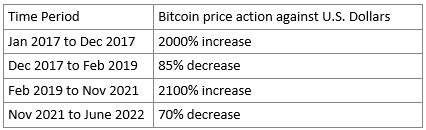
Yet despite all the volatility, the technology hasn't undergone many changes.
The blockchain continues to be able to handle 3-7 transactions per second (a fraction of what Visa can handle) though this has since changed with the addition of the Lightning Network layer that is able to support up to 1 million transactions per second.
It continues to be a decentralized with the blockchain secured by individuals throughout the world instead of governments.
Supply of the token has also remain unchanged at a max possible 21 million tokens representing scarcity while the transferability and divisibility of Bitcoin ensures that it can be easily used as a form of exchange.
On a whole, the characteristics of Bitcoin have largely stayed the same. Ironically, it is these unchanging characteristics of Bitcoin that have cemented its relevance in today's world where centralized forms of money have demonstrated certain negligence in function.
I highly recommend reading A Brief History of money by Haseeb Qureshi for a deeper dive into what makes money. For those of you who would prefer a simple summary, the article goes through how barter acted as a first form of exchange until modern banking adopted asset backed issuance of bank notes to form what we now know as currency. This concept then became centralized by the state and while states initially held reserves in gold as a form of backing, overprinting of money eventually resulted in a gold de-pegging. Henceforth, the modern form of money termed "Fiat", is entirely backed by the word of governments and the state.
This becomes an issue because with little accountability, governments can freely control the supply and deployment of money. In some cases, this deployment of funds can be questionable as they force future generations to bear the brunt of policy action. In other instances, the availability of money can be politicized or even outrightly abused.
During the 2008 financial crisis, federally backed mortgage companies Freddie Mac and Fannie Mae received $190 billion in bailout funding while numerous banks, AIG and General Motors received capital injections in the form of equity purchases by the government. This printing of money also known as quantitative easing may have been the lesser evil in preventing a systemic default and the collapse of the U.S. financial and banking system. Nonetheless, the effects of the bailout were eventually felt down the road in 2013 as quantitative tightening led to the taper tantrum. If you were fresh out of school then, the harder prospects of finding a job while not completely unjustified may have seemed unfair.
More recently in 2022, Russia's invasion of Ukraine was met by a retaliation by G7 central banks that worked together to freeze foreign currency assets held by Russia's central bank. This was the equivalent of dropping of a financially nuclear bomb and while done as a clear retaliation to Russia's deplorable act, thoroughly violates the principles of money as fair medium of exchange. Foreign assets held by Russia's central bank essentially became worthless overnight while physical assets belonging to Russian Oligarchs were seized too. This is certainly not the first time the U.S. or other governments have adopted such an overt approach. Afghan assets were frozen as a retaliation to 9/11 and the U.S. has also frozen foreign exchange dollar denominated reserves in other middle eastern countries in the past. Politics aside, these acts essentially mean that the one with the biggest stick can dole out the punishments. Not every Russian supports the war but the sanctioning of Russian assets affects all of them the same. Thus far, the western world has been largely immune to such financial actions but the new world era where military and financial power is gradually shifting in China's favor could mean that one day, Americans may be on the receiving end of such treatment.
My third example exemplifies how corrupt parties in power can potentially exploit a nation's resources for their own gain. The 1MDB scandal in Malaysia is perhaps one of the biggest examples of alleged misappropriation of power by a nation's Prime Minister. Between 2009 to 2015, US$4 Billion of state funds were embezzled and laundered to finance the lavish lifestyles of associates of then Malaysia Prime Minister Najib Razak. State funds were spent of yacht parties, luxury items and even the production of the movie "The Wolf of Wall Street". The United States Department of Justice has declared the 1MDB scandal as the "largest kleptocracy case to date" and while ex-Prime Minster Najib himself miraculously remains unimplicated, the Malaysian public has been left to bear the debt. The Malaysian Ringgit has since been on a gradual pace of depreciation against the U.S. Dollar and has lost 20% of its value against the U.S. Dollar over the past 7 years.
The story of struggling masses against a corrupt authority is nothing new. However, the advancement of blockchain technology has enabled new solutions to come to the forefront. Bitcoin famously sprung from the aftermath of the 2008 financial crisis and with increasing political polarization in the U.S, Europe and even China, more and more individuals have started to recognize Bitcoin as an alternative store of value ungoverned by any single entity.
While this may be bullish for Bitcoin's overall case, the asset still faces headwinds that could impede its widespread adoption.
Firstly, the privacy that the blockchain entails means that it can be used by criminals to launder money. The crypto community remains split on this as many cite the successful arrest of Bitcoin fraudsters Ilya Lichtenstein and Heather Morgan who laundered $4.5 Billion worth of Bitcoin as an example of how transactions on the blockchain can ultimately be traced with due effort. In fact, following the arrest, the United States Justice Department made the statement that "Today’s arrests, and the department’s largest financial seizure ever, show that cryptocurrency is not a safe haven for criminals." I'm personally not too sure about that as the details of the investigation showed that storing of private keys on an iCloud network enabled authorities to retrieve funds. Either way, it is clear that there will always be bad actors in any environment and the cryptoverse isn't any exception.
Secondly, the volatility of Bitcoin continues to be an issue. Prices of goods and services continue to be quoted in USD instead of BTC and with the rapid fluctuations in the price of Bitcoin, merchants and suppliers will find it challenging to list goods denominated in BTC. Increased adoption of Bitcoin by more individuals and companies is the easiest way to resolve this problem as diluting the concentration of BTC into more hands has a natural stabilizing effect on prices. This may end up being a bit of a chicken and egg scenario as prices need to first stabilize before more money can flow into this space.
This brings me back to the conversation I had in 2017. My colleague and I were talking about Bitcoin's intrinsic value but what we failed to understand was that value is often a relative concept. Much like how a bar of chocolate could be worth more or less depending on how hungry you are, the value of a digital construct that operates on a secure decentralized network can be ascribed to the degree of trust individuals have in their country's monetary system and the presence of available alternatives.
Thank you for taking the time to read this article. I hope you've enjoyed reading it on the site and I look forward to bringing more of such pieces to you.